
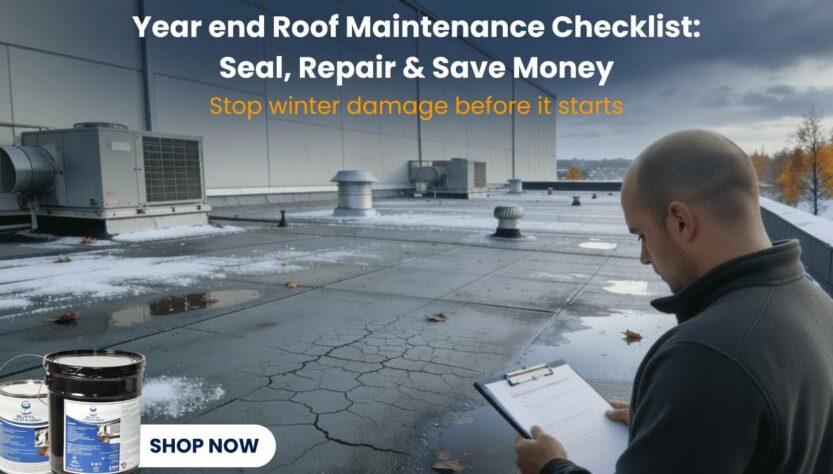
Let’s face it: by the time December rolls around, the last thing you want to think about is your roof. You’re busy closing out the year, planning for the holidays, and managing a thousand other priorities. But if you own a commercial building or even a flat-roofed residential property, ignoring that expanse above your head right now is a gamble you really shouldn’t take.
Winter is unforgiving. It doesn’t consider your budget or schedule. The freeze-thaw cycle—where water seeps into tiny cracks during the day and freezes at night—is the single biggest enemy of any roofing system. As that ice expands, it forces those tiny cracks wide open. What starts as a hairline fracture in November becomes a ceiling bucket brigade by February.
The good news? You don’t need a complete tear-off to protect your investment. In fact, most “replacements” are unnecessary expenses that could have been avoided with proper maintenance and a high-quality coating. If you want to keep your money in your pocket and your tenants dry, here is your practical, no-nonsense year-end checklist.
1. The “Boots on the Roof” Inspection
You can’t fix what you haven’t seen. Pick a clear, dry day and get up there. You aren’t just looking for obvious holes; you’re playing detective. Walk the entire perimeter.
Look closely at the seams. On an epdm rubber roof, seams are often the first to fail as the adhesive ages and loses its grip. Are they lifting? Curling? If you see any separation, that’s a red flag.
Check for “alligatoring.” This is when the surface of an old coating appears cracked and dry, resembling reptile skin. It means the existing material has lost its elasticity. It can no longer stretch and move with the building, which means the next cold snap could cause the membrane to fail.
And don’t forget to look for ponding water. If you see stained rings where water clearly sits for days after a rain, pay attention. Most standard roof coatings—especially the water-based acrylics you find at big box stores—will disintegrate under standing water. They can’t handle it. You need to know where these trouble spots are so you can treat them with a product that actually works underwater (more on that in a minute).
2. Clear the Debris (The Boring but Critical Step)
It sounds simple, but you’d be amazed at how many expensive leaks are caused by a pile of wet leaves. Debris acts like a sponge, holding moisture against your roof membrane for weeks. It also prevents water from reaching the drains.
Sweep it all off. Clear the gutters, scuppers, and downspouts. If water can’t leave your roof, it’s going to try to get into your building. While you’re cleaning, this is the perfect time to use a specialized cleaner like Roof Protect. You need to remove oxidation, dirt, and oily residue that accumulate over time. If you try to apply a patch or coating over a dirty roof, you’re just painting dirt. It won’t stick, and you’ll be doing this again in six months.
3. Seal the Penetrations
Every pipe, vent, HVAC unit, and skylight poking through your roof is a potential leak waiting to happen. These “penetrations” vibrate and move differently from the rest of the roof, which stresses the seals.
Check the flashing around these units. Is the old caulk brittle? Is it pulling away? This is where you need a heavy-duty solution. Don’t just squirt some cheap silicone in there. For gaps larger than 1/16 inch, or for seams that have begun to open, use a dedicated seam sealer like Seam-Tite.
Ideally, apply a heavy bead of sealant, and for serious gaps, embed poly fabric mesh while it’s wet. This creates a reinforced “bridge” across the gap, far stronger than the roof itself. It’s a simple aftermarket repair that can add years to the roof’s life without a contractor’s massive bill.
4. The One-Coat Solution: Liquid Butyl Rubber
Here is where the “Save Money” part of the title really kicks in.
If your inspection revealed an aging surface, widespread crazing, or just a roof that has seen better days, your first instinct might be to call a roofer for a quote. Be prepared for sticker shock. A complete tear-off and replacement can cost tens of thousands of dollars.
Or, you could restore it for a fraction of the cost.
This is where specific product chemistry matters. Most DIY sealants are water-based acrylics. They are inexpensive, but they have a fatal flaw: they are essentially water-soluble until cured, and even then they break down when water is present. Plus, they freeze.
For an accurate year-end fix, consider solvent-based elastomeric roof coatings, specifically Liquid Butyl Rubber.
Why is it “Liquid Butyl”?
- It’s a One-Coat System: Unlike other systems that require a primer, a base coat, and a top coat (adding labor and weight), Liquid Butyl Rubber goes on in one thick application. It saves you time, which is money.
- Chemical Bonding: It doesn’t just sit on top of your roof; it chemically cross-links with the surface. It fuses with your existing EPDM, metal, or concrete roof to form a seamless membrane.
- Ponding Water Defense: This is the game-changer. Liquid Butyl Rubber is one of the only coatings that can withstand ponding water 365 days a year without bubbling or peeling. If your flat roof isn’t perfectly sloped (and whose is?), this is the only viable option.
- Temperature Fighter: It remains flexible down to -40°F. When your building shifts in the dead of winter, this coating stretches (up to 500% elongation) rather than cracking.
5. Why Solvent-Based is the Smart Choice for Winter
You might wonder why we emphasize “solvent-based.” It comes down to the drying process. Water-based coatings dry by evaporation. If it’s cold or humid (like it often is in late autumn), they might never cure properly. They trap moisture underneath, which freezes and ruins the job.
Liquid Butyl Rubber cures through a chemical reaction. It forces trapped air up and out, creating a denser, tighter bond. This process performs better across varied climates and yields a thicker final film—typically 20 mils in a single coat —compared to the thin layers you get from other products.
See why epdm coatings are better then traditional coatings.
Conclusion: Don’t Wait for the Drip
Roof maintenance isn’t glamorous. It’s not something you show off to your friends. But do you know what’s even less glamorous? Placing buckets on your conference table during a January thaw.
By taking a weekend now to inspect, clean, and potentially coat your roof with a proper epdm roof repair solution, you aren’t just patching a hole. You are extending the life of your existing roof by 18 to 20 years. You are stopping the cycle of constant repairs. And most importantly, you are keeping your hard-earned money where it belongs: in your business, not on your roof.
Check your roof this week. If you see issues, grab a bucket of Liquid Butyl Rubber and fix it for good. In the future, you will be grateful.
For more information, visit EPDM Coatings or call us at 855-281-0940.