
As winter approaches, the integrity of your roof faces its most formidable challenge. The combination of freezing temperatures, heavy snow loads, and the relentless cycle of thawing and refreezing can expose every weakness in a roofing system. For property owners considering a roof restoration, the choice often comes down to two popular options: water-based acrylics (usually labeled generally as elastomeric coatings) and solvent-based liquid rubber.
While acrylics might look appealing on the shelf due to a lower upfront price tag per gallon, the real test happens when the temperature drops. We’ve analyzed the performance data and field results to see how these two contenders stack up in an actual winter durability test.
The Chemistry of Cold: Why Liquid Rubber Outperforms Water-Based Acrylics.
To understand why these coatings behave differently in winter, you have to look at their chemistry. It is a battle between evaporation and chemical cross-linking.
Acrylic Coatings are water-based. Like any water-based product, they rely entirely on evaporation to cure. This creates a significant limitation during the colder months. If the temperature drops below 50°F or the dew point rises, curing stops. Even worse, if the water trapped inside the coating freezes before it fully cures, the product is ruined. It essentially turns into a brittle film that loses adhesion and washes away with the first rain or snowmelt.
In contrast, Liquid Rubber (specifically Liquid EPDM or Butyl Rubber) is solvent-based. It doesn’t rely on evaporation in the same way. Instead, it cures via chemical cross-linking. This is a game-changer for winter durability. Our liquid EPDM products cure chemically, not just by drying. If the temperature drops below freezing during the curing process, the reaction simply “pauses” (goes dormant) and resumes once it warms up again. The cold doesn’t destroy the coating; it just waits.
Furthermore, a solvent-based liquid roof becomes waterproof within roughly 2 to 3 hours of application. A sudden winter shower or evening dew won’t wash it off. Conversely, acrylics often require 24 to 48 hours of warm, dry weather to resist wash-off—a window that is increasingly hard to find as winter sets in.
Elastomeric Roof Coatings vs. The Freeze-Thaw Cycle
The most destructive force in winter isn’t just the cold air—it’s the movement of the building. Roofs expand and contract dramatically as temperatures fluctuate between day and night (thermal shock).
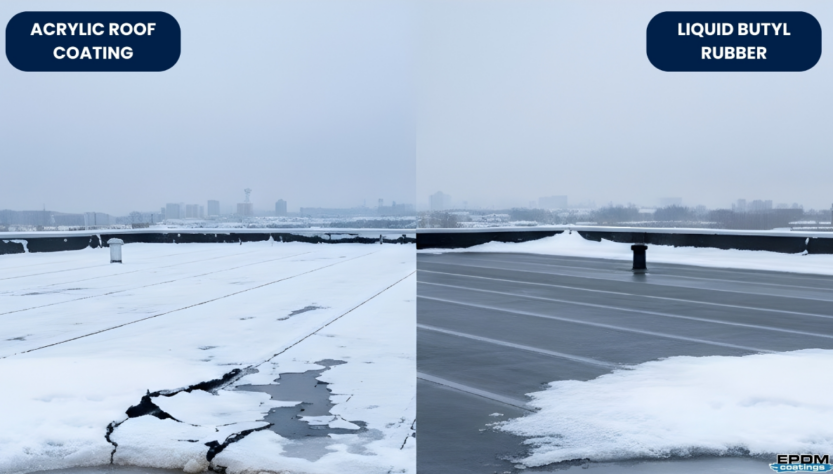
The Acrylic Failure Mode: Standard water-based elastomeric roof coatings tend to lose flexibility as they age and cool. In freezing temperatures, they can become rigid when your roof membrane contracts in the deep cold, and a brittle acrylic coating can’t move with it. The result is cracking and delamination. Once the coating cracks, water seeps beneath it, freezes, expands, and pulls the coating further away from the roof. This is often referred to in the industry as the “zipper effect” of coating failure.
The Liquid Rubber Advantage: True liquid rubber boasts an elongation of over 500%. It remains flexible in temperatures as low as -60°F and stable up to 300°F. This incredible elasticity means that when your roof shrinks in the cold, the coating stretches and contracts right along with it. It absorbs the thermal shock without cracking, maintaining a seamless seal throughout the harshest winter cycles. It essentially acts as a “living” skin for your roof, adapting to the environment rather than fighting it.
Liquid EPDM: The Solution for Ponding Water and Snow Melt
Flat and low-slope roofs are notorious for ponding water. In winter, this manifests as sitting snow and ice that slowly melt during the day and freeze at night. This specific condition is where the difference between the two products becomes undeniable.
Acrylics and Re-emulsification: Most acrylic coatings are “breathable.” While this sounds positive, in a roofing context, it often means they are permeable to water intrusion. When snow sits on an acrylic-coated roof and melts, that water pools. Over time, acrylics can undergo “re-emulsification,” where the standing water breaks down the binder, causing the coating to turn to mush, bubble, and peel off. This is why many acrylic warranties explicitly exclude damage from ponding water—they know the product cannot handle it.
Liquid EPDM Impermeability: Solvent-based liquid EPDM coatings are chemically cross-linked to form a non-permeable membrane. They are designed to withstand ponding water 365 days a year. Whether it’s a puddle that never dries or a pile of melting snow, the coating will not soften, bubble, or peel. It fuses to the substrate—whether it’s aged EPDM, metal, or concrete—forming a bond that prevents moisture penetration. This makes it ideal for flat roofs where drainage might not be perfect.
Application Windows: When to Apply Your Liquid Roof
Preparing for winter is often a race against the clock. The leaves are falling, the days are getting shorter, and the rains are coming. This is where the application method impacts your “winter readiness” and your labor costs.
Acrylic Systems: To achieve decent performance with an acrylic, you typically need a primer followed by two or three coats to build up the required thickness (mils). Each coat requires significant dry time. In the short days of autumn, finding three consecutive days of perfect, warm weather to apply a multi-coat system is nearly impossible. You might get the primer down, but if the weather turns before the topcoats are used, the system fails.
Liquid Rubber Systems: Our Liquid Butyl Rubber and EPDM products are true one-coat systems. They generally do not require a primer for most surfaces (including aged EPDM, metal, and fiberglass). You clean the roof, apply the coating, and you’re done. You get a thick, protective film in a single pass. This efficiency allows you to seal your roof in a single afternoon, beating the winter weather before it arrives. This “one-and-done” application not only saves time but also significantly reduces labor costs, often lowering the total project cost compared with “cheaper” acrylics.
The Verdict: Investing in Liquid Rubber for Long-Term Protection
When you compare the complex data, the difference is stark. Acrylics require ideal weather for application, become brittle in cold weather, and fail under standing water. They are essentially a fair-weather solution that requires constant maintenance and re-coating.
Liquid Rubber stands alone as the industrial-grade solution for winter protection. Its ability to bond chemically, withstand extreme temperature swings without cracking, and tolerate ponding water make it the only viable choice for long-term durability.
Don’t let this winter be the one that compromises your building’s envelope. By choosing a solvent-based liquid roof solution, you aren’t just painting your roof; you are creating a seamless, rubberized shield that ignores the thermometer and keeps your property dry, season after season. It is an investment in peace of mind that pays dividends every time the snow falls.