
If you’ve ever spent a weekend on a ladder, you know the sinking feeling of reading a product label and realizing “one coat” actually means “one coat of primer, two coats of base, and a finisher.” By the time you’re done, you’ve spent three times the money on labor and materials, and you’re still crossing your fingers that the layers actually stick together.
At EPDM Coatings, we’ve seen this cycle play out far too often. Most elastomeric roof coatings on the market are water-based. While they’re easy to find at big-box stores, they have a major flaw: they shrink. To get any real protection, you have to stack layers like a wedding cake.
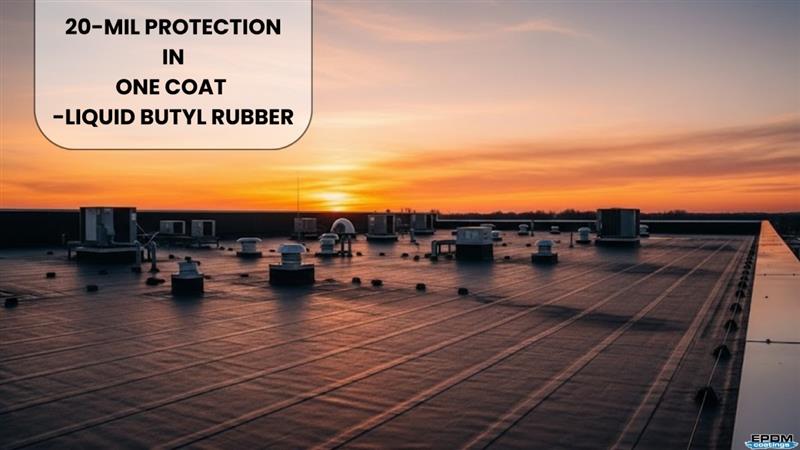
We decided to do things differently. Our Liquid Butyl Rubber provides a massive 20-mil shield in a single pass: no waste, no “re-coating” next weekend, and no unnecessary stress.
The Problem with the “Layer Cake” Approach
Traditional roof repair coatings are mostly water-based. As the water evaporates, the coating thins. This leads to a few common—and expensive—problems:
- Inter-coat Delamination: When you apply multiple layers, you rely on the bond between them. If there’s even a bit of dust or morning dew between coat one and coat two, they will eventually peel apart.
- The Labor Trap: Your time (or your contractor’s time) is expensive. Applying three coats doesn’t just take three times as long; it requires three different windows of perfect weather.
- The Shrinkage Factor: If you start with 20 mils of a water-based product, you might only end up with 8 or 10 mils of actual protection once it dries. That’s just not enough to handle the “real world.”
Why One Coat is Actually Better
Our epdm rubber solution is solvent-based. Because it doesn’t rely on evaporation, what you put down stays there. When you spread it at 50 square feet per gallon, you get a thick, rugged membrane that doesn’t shrink into a thin film. It’s a “one and done” philosophy that actually works.
A Chemical Bond, Not Just a Surface Grip
Most coatings act like tape—they stick to the surface. But tape can be peeled off. Liquid Butyl Rubber acts more like a weld.
The secret is in the catalytic cure. As the product sets, it undergoes chemical cross-linking. If you’re applying it over an old epdm rubber roof, it actually “re-vulcanizes.” It fuses into the old membrane, turning two separate pieces of material into one seamless, monolithic sheet.
This means:
- You can skip the primer: On most surfaces (metal, fiberglass, or weathered EPDM), you don’t need a separate primer coat. The product is designed to bite into the substrate independently.
- It breathes: While it’s curing, it naturally pushes out any trapped air. This prevents those annoying bubbles and blisters that usually show up a week after a “standard” coating job.
Handling the “Roof Killers”: Standing Water and UV
If you have a flat roof, you probably have ponding water. It’s the number one cause of failure for elastomeric roof coatings.
Water-based coatings are “hydrophilic”—they eventually absorb standing water, soften, and revert to a milky liquid. Liquid Butyl Rubber is “hydrophobic.” It doesn’t care if water sits on it for a day or a month. It’s the same material used to line ponds and containment pits, so a little rain puddle on your roof isn’t going to hurt it.
Then there’s the sun. UV rays turn most roof repair coatings brittle. They lose their stretch, and then they crack. Our formula has built-in UV stabilizers that keep it flexible for decades. It can stretch up to 500% of its original size and snap right back. Whether it’s a 100°F summer day or a -40°F winter night, the seal stays tight.
Where Can You Use It?
We built this to be a universal problem-solver. It’s not just for industrial warehouses; it’s for anything that needs to stay dry:
- Metal Roofs: It stops rust in its tracks and seals those pesky leaking fasteners.
- RVs and Campers: It survives the “earthquake” of highway travel and the constant vibration that cracks cheaper silicones.
- Flat and Low-Slope Commercial Roofs: It turns a leaking, aging roof into a new system without the cost of a full tear-off.
How to Get It Right (The Human Guide)
You don’t need a PhD or a $10,000 spray rig to do this. You need a roller, a brush, and a bit of common sense.
- Clean it well: The only way to mess this up is to apply it over loose dirt or grease. A good power wash (and letting it dry!) is 90% of the work.
- Mix it thoroughly: Since it’s a catalyzed product, use a drill mixer to ensure the “magic” is evenly distributed throughout the bucket.
- Pour and Spread: It’s self-leveling. If you see a few roller marks, don’t panic—they’ll flatten out on their own into a smooth, rubberized finish.
- The “Rain Window”: It’s waterproof in about 2–3 hours. If a surprise shower hits after that, you’re fine. Curing pauses and resumes once it’s dry again.
The Bottom Line
We know there are cheaper buckets of “white paint” at the store. But those products are designed to be sold, not necessarily to last. When you factor in the cost of buying three times the material and doing the work three times over, the “expensive” one-coat solution actually ends up being the cheapest over the life of your roof.
Liquid Butyl Rubber from EPDM Coatings is about giving you your weekends back and giving your building a roof that actually performs.