
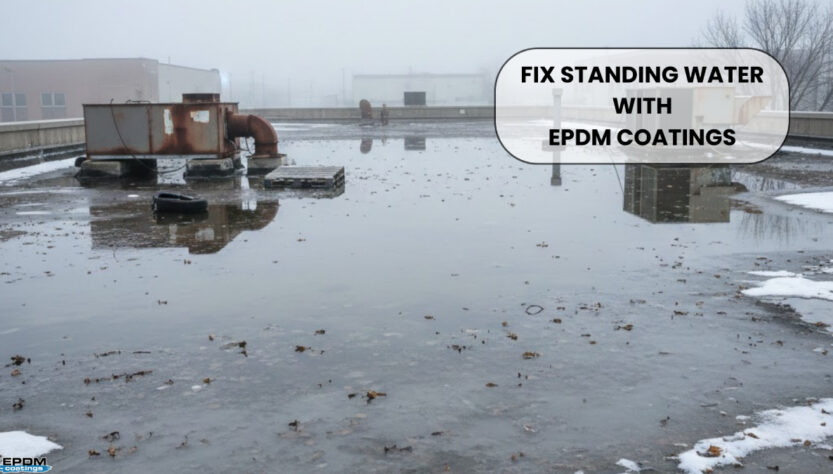
If you own a building with a flat roof, you have likely experienced “after-rain anxiety.” You climb the ladder, see a massive, shimmering puddle that isn’t draining, and you know it’s only a matter of time before that moisture finds a path into your structural decking. In the roofing industry, we call this “ponding water,” and for 90% of traditional materials, it is a slow-motion disaster.
At epdm coatings, we provide a solution engineered to handle these exact conditions. Most off-the-shelf fixes are temporary bandages that fail when submerged. To truly protect your investment, you need to understand the molecular science behind liquid butyl rubber. This isn’t just a coat of paint; it is a high-performance, solvent-based membrane designed to remain submerged 365 days a year without compromising structural integrity.
Chemistry of 365-Day Performance: Why Liquid Butyl Rubber Dominates
The primary reason most roof coatings fail when exposed to standing water is their base chemistry. Most consumer-grade products are water-based acrylics or elastomers. While these are easy to find, they are “hydrophilic,” meaning they can re-emulsify—or essentially revert to a liquid state—when submerged for extended periods.
In contrast, butyl liquid rubber is a solvent-based system. This distinction is critical for engineering a truly waterproof barrier. Because it is hydrophobic, it does not soften or weaken when water is applied to it. Our product is specifically engineered to withstand ponding water literally 365 days a year. It is one of the only roofing products in the U.S. warranted against standing water on flat surfaces, providing a level of security that water-based alternatives cannot match.
Overcoming Thermal Shock: 500% Elongation in EPDM Coatings
Roofs are dynamic structures. Depending on the climate, a roof can experience temperature swings from -40°F in the winter to over 250°F in the peak of summer. This constant expansion and contraction, known as thermal shock, is what causes standard coatings to crack, flake, and eventually leak.
EPDM coatings solve this problem through their extreme elasticity. With a 500% elongation rating and high tensile strength, liquid butyl rubber moves in perfect synchronization with your building. Whether metal roof fasteners are shifting or a concrete deck is expanding, the membrane remains intact. It maintains its flexibility even at -60°F, ensuring the “365-day waterproof” promise holds regardless of the season or weather conditions.
The 20-Mil Shield: Engineering Depth in a Single Coat of Liquid Butyl Rubber
In the world of professional roofing, mil thickness (the measurement of the dry film) is the metric that matters most. Many competitors require three or four separate coats to achieve a protective thickness, which drastically increases labor costs and the risk of “interlayer delamination”—where the layers peel apart.
Butyl liquid rubber is engineered for a single-coat application, yielding a substantial 20-mil dry-film thickness. This high-solids formulation provides several engineering advantages:
- Immediate Waterproofing: It becomes rain-safe within 2–3 hours of application, so a sudden afternoon storm won’t ruin your hard work.
- Seamless Protection: Because it is a liquid, it encapsulates seams, fasteners, and flashings, eliminating the “weakest links” where leaks usually start.
- Air-Release Technology: As the product cures, it naturally forces trapped air to the surface, preventing the blisters and bubbles that plague elastomeric systems.
Versatility Across Substrates: How EPDM Coatings Solve Complex Problems
One of the most impressive feats of butyl liquid rubber engineering is its universal adhesion. It is a true problem-solver for almost any surface, making it the most versatile tool in a facility manager’s arsenal.
- Metal Roofs: It acts as a rust inhibitor and UV stabilizer, stopping corrosion in its tracks without the need for specialized primers. It seals around vibrating bolts that would otherwise back out, causing leaks.
- Concrete: It bridges the pores, preventing freeze-thaw cycles that cause structural cracking.
- Existing EPDM and TPO: It chemically fuses to existing rubber membranes, essentially “re-vulcanizing” weathered roofs back to their original performance levels.
Because no primer is needed for most applications (including weathered EPDM), the total project cost is significantly lower than for multi-coat systems, even though the material itself is of a much higher industrial grade.
UV Stability and Energy Efficiency: The “Cool Roof” Advantage
Engineering a roof for standing water also requires protecting it from the sun. Ultraviolet (UV) radiation is a primary “roof killer,” breaking down chemical bonds and making materials brittle. Once a material becomes brittle, standing water can easily cause a breakthrough.
The “White” version of our liquid butyl rubber is an Energy Star-qualified product that reflects up to 90% of solar heat. By reducing the roof’s surface temperature, the coating not only protects the building’s structural integrity but also significantly lowers cooling costs. This reflectivity does not degrade over time, ensuring that the energy-saving benefits last as long as the waterproofing itself—often for more than two decades.
The Human Side of High-End Engineering: DIY Friendly Liquid Rubber
While the science behind epdm coatings is complex, the application is intentionally simple. You don’t need a professional crew, expensive insurance, or specialized spray equipment for most residential or small commercial jobs. If you can use a 3/8-inch nap roller and a drill mixer, you can apply this professional-grade solution.
The product comes with a built-in catalyst. Once mixed, you pour and roll. The self-leveling properties of the liquid butyl rubber mean that roller marks disappear as it dries, leaving a smooth, professional-looking finish. This empowers property owners to take control of their maintenance without the astronomical costs of a full roof replacement.
Final Analysis: Why Property Owners Choose Liquid Butyl Rubber
When it comes to protecting your property, the “cheapest” option is rarely the most economical in the long run. Water-based coatings that require frequent reapplication and fail at the first sign of ponding are a drain on your time and budget.
By choosing butyl liquid rubber, you are choosing a solution backed by decades of field success and rigorous ASTM testing. It is a system designed to withstand the harshest environments—from saltwater marine settings to heavy industrial warehouses—and the only way to ensure your flat roof remains leak-free 365 days a year, regardless of how much water collects on top.
Don’t settle for temporary fixes that wash away. Explore the full range of epdm coatings today and give your roof the industrial-strength protection it deserves. For more technical specifications, safety data sheets, or to start your project, visit epdm coatings and see why we remain the #1 recommended solution for roof repair across the USA.