
When it comes to restoring a flat or low-slope roof, the terminology can be overwhelming. You’ll hear terms like “elastomeric,” “acrylic,” “solvent-based,” and “liquid rubber” thrown around, often interchangeably. However, for property owners looking for a long-term solution, understanding the distinct chemical differences between these products is critical. Choosing the wrong coating can lead to wasted labor, repeated repairs, and—worst of all—continued leaks.
In this guide, we will break down the critical differences between standard water-based elastomeric coatings and genuine liquid rubber roof coating solutions like Liquid Butyl Rubber. By understanding the science behind how these products cure and bond, you can make an informed decision that saves you time and money in the long run.
Understanding the Contenders: Water-Based vs. Solvent-Based
To truly compare these options, we must look at their chemistry.
Elastomeric (Acrylic) Coatings:
Most products labeled simply as “elastomeric coatings” found in big-box stores are water-based acrylics. These products cure through evaporation—meaning the water in the product evaporates into the air, leaving a dried film behind. While they are often marketed as an easy, eco-friendly fix, they have significant limitations when exposed to the harsh realities of flat roofing, particularly when standing water accumulates.
Liquid Butyl Rubber (Solvent-Based):
On the other side of the spectrum is EPDM roof sealant based on butyl rubber chemistry. Unlike water-based acrylics, Liquid Butyl Rubber is a solvent-based system. It doesn’t just dry; it undergoes a chemical reaction. As the product cures, it chemically cross-links, creating a bond that fuses the coating and the roof substrate into one. This unique catalytic curing process allows for a stronger, more durable membrane that is fundamentally different from a simple dried paint film.
The Achilles Heel: Ponding Water
The single biggest differentiator between these two types of coatings is their ability to handle ponding water.
Flat roofs are notorious for collecting water. If you have low spots on your roof where water sits for more than 48 hours, you have “ponding water.”
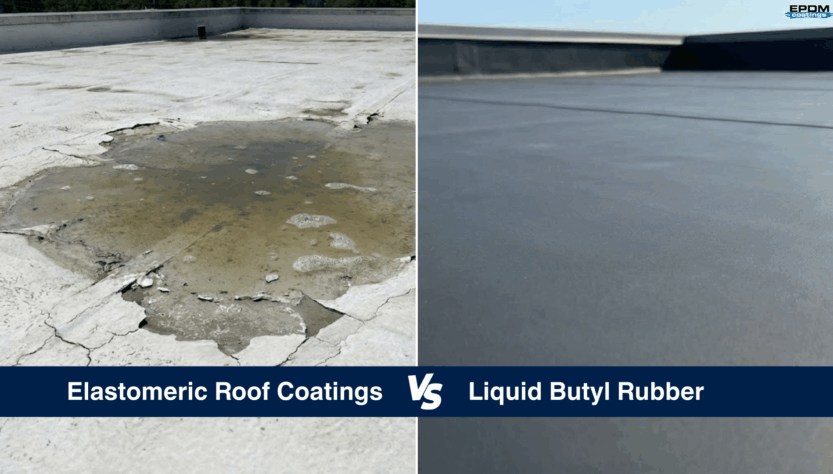
- The Elastomeric Failure: Water-based acrylic coatings are essentially breathable. While this sounds good in theory, in practice, it means they are susceptible to re-emulsification. When water sits on an acrylic coating for extended periods, the coating can begin to soften, bubble, and eventually delaminate from the roof. This is why many elastomeric warranties explicitly exclude damage caused by ponding water.
- The Liquid Butyl Advantage: Liquid roof repair coatings like Liquid Butyl Rubber are designed to withstand ponding water 365 days a year. Because the product is solvent-based and chemically cross-linked, it is completely impermeable to water once cured. It will not soften, bubble, or peel, even if under water for weeks at a time. For a flat roof owner, this peace of mind is invaluable.
The Science of Durability: Tensile Strength and Elongation
Roofs are dynamic structures. They expand in the summer heat and contract in the winter freeze. A roof coating must be able to move with the roof without cracking.
Standard elastomers often become brittle over time, especially after exposure to UV rays and freeze/thaw cycles. When the underlying roof expands, a brittle coating cracks, leading to immediate leaks.
Liquid Butyl Rubber, however, boasts 500% elongation and tensile strength over 1520 psi. This incredible elasticity allows it to handle significant thermal shock—expanding and contracting with your roof through temperature swings ranging from -60°F to over 200°F. This is why other coatings tend to crack after a few years, while Liquid Butyl Rubber maintains its integrity.
Furthermore, the drying process of Liquid Butyl Rubber forces trapped air out and up to the surface. In other types of coatings, trapped air can cause blisters that eventually pop and leak. The chemistry of Liquid Butyl Rubber ensures a smooth, seamless membrane that is chemically fused to the surface.
The “One-Coat” Economics: Why Cheaper Can Be More Expensive
When shopping for EPDM roof leak repair products, it is easy to be tempted by the lower price per gallon of acrylic coatings. However, the actual cost of a roof restoration project goes beyond the sticker price of the bucket. You must calculate the “cost per square foot per year of service”.
The Multi-Coat Trap:
Most water-based elastomeric systems require a rigorous application process to achieve a warranty-backed result. This typically involves:
- A specific primer coat (additional cost).
- A base coat.
- A top coat.
- Sometimes, even a fabric reinforcement layer is used between coats.
Each of these steps adds material cost and, more importantly, significant labor cost. You are effectively painting your roof three or four times.
The Liquid Butyl Solution:
Liquid Butyl Rubber is an actual one-coat process. In most cases, no primer is needed. You clean the roof, apply the product, and you are done.
- No Primer: Liquid Butyl Rubber can be applied directly over EPDM, TPO, metal, excessive rust, and even aged asphalt layers without a primer.
- Thickness: A single application results in a 20-mil dry film thickness. To achieve the same level of protection with standard coatings, you would need 2 or 3 coats.
When you factor in the savings on primer and the massive reduction in labor hours, the overall project cost of Liquid Butyl Rubber is often comparable to or lower than “cheaper” alternatives—and that’s before you factor in the lifespan. Field testing has shown that Liquid Butyl Rubber outlasts elastomeric acrylics and urethanes three times, meaning you won’t have to repeat this dirty job in a few years.
Versatility and Ease of Application
One of the main reasons contractors recommend Liquid Butyl Rubber throughout the USA is its versatility. It takes the guesswork out of compatibility.
- Weather Independence: Solvent-based coatings are significantly less susceptible to climate conditions during application. While water-based coatings can be ruined by unexpected light rain or freezing temperatures shortly after application, Liquid Butyl Rubber is much more robust.
- Universal Adhesion: Whether you are fixing an RV roof, a commercial metal warehouse, or a residential flat roof, the product works. It has been the #1 choice for a proven alternative to total roof replacement.
Application Tip:
For a successful application, surface preparation is essential but straightforward. The surface should be clean and dry. We recommend using a product like Roof Protect to lift dirt and grease chemically. Once clean, Liquid Butyl Rubber can be applied with a standard 3/8” nap roller, much like painting a floor. For larger commercial jobs, airless sprayers can also be used to save time.
Conclusion
When you look at the data—tensile strength, elongation, ponding water resistance, and life expectancy—the choice becomes clear. While elastomeric acrylics have their place in low-stakes environments, they cannot compete with the industrial-grade performance of solvent-based rubber.
If you want to extend your roof’s life by another 18-20 years with a single application, Liquid Butyl Rubber is the superior choice. It saves you from the “hidden costs” of primers and multiple coats, and it provides a level of waterproofing certainty that water-based products cannot match.
Don’t settle for a temporary fix. Choose the product that fuses to your roof and provides a seamless, leak-free barrier for decades to come.
Check out EPDM Coatings product store or call at : 855-281-0940 to give orders.