
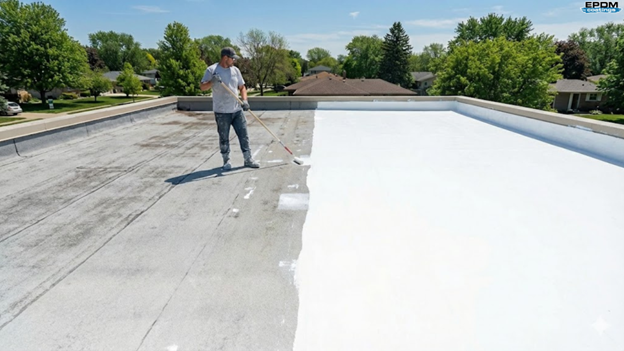
I remember talking to a homeowner last year who was staring at a roof-replacement quote for $35,000. Her flat roof was aging, showing signs of wear, and she was terrified about what would happen if it started leaking into her attic. Then she discovered liquid roof technology, and honestly, it changed her perspective on the whole situation. Instead of that massive expense, she was able to protect her home for a fraction of the cost. That conversation stuck with me because it illustrates why residential rubber roofing has become a game-changer for many homeowners.
If you have a flat or low-slope roof, you probably know the stress that comes with it. Water pools up. You worry about leaks. Contractors throw around big numbers for “replacement” without really exploring what might be possible. The truth is, there is a smarter path forward: Liquid Butyl Rubber. This rubberized roof coating has quietly become the most recommended solution among contractors across the United States.
Why Your Roof Doesn’t Need to Be Replaced
Here is what most homeowners do not realize: your roof may not be complete yet. It might just need protection.
Over the past 25 years, Liquid Butyl Rubber has proven effective, extending roof life by 18 to 20 additional years. Think about that for a moment. Instead of ripping off what you have and starting over, you are giving your existing roof a second wind. Your home stays protected. Your budget stays intact. And you get peace of mind knowing that your roof will hold strong for nearly two more decades.
The key to making this work is choosing the right product from the start. I have seen too many homeowners try cheaper solutions, only to find themselves right back where they started three or four years later, dealing with cracks and leaks again. That is why it matters so much to understand what makes EPDM Coatings Liquid Butyl Rubber different.
Understanding the Chemistry Behind Rubber Roofing
Most people do not consider the science when evaluating roofing products. But the chemistry explains why this solution works so well and lasts so long.
When Liquid Butyl Rubber dries on your roof, something remarkable happens. The product does not just sit on top of your existing surface like a coat of paint. Instead, it chemically cross-links with your roof, effectively fusing the coating and your roof into a single structure. It is like they become permanently bonded at a molecular level.
During this drying and curing process, the product does something else that is really clever: it forces trapped air up and out to the surface. This might sound like a minor detail, but it is actually huge. You know why other coatings—especially those elastomeric roof coatings and water-based systems—tend to crack within a few years? Trapped air. As that air expands and contracts with temperature changes, it creates weak spots and hairline fractures. Liquid Butyl Rubber avoids this problem entirely by pushing that air out before it can cause damage.
Once everything cures, you end up with a remarkable, seamless membrane that can stretch with your roof. We are talking 500% elongation and over 1,520 psi of tensile strength. Translation? When your roof expands in summer heat or contracts in winter cold, this coating moves with it. It does not crack. It does not fail. It just keeps protecting.
Why Solvent-Based is Better Than Water-Based
Walk into any home improvement store, and you will see all kinds of roof coating options. Some are water-based. Some are solvent-based. If you are trying to decide which option to choose, here is the honest answer: solvent-based is better for your home.
Solvent-based coatings, such as Liquid Butyl Rubber, are significantly less susceptible to climate conditions, freezing temperatures, and extreme weather. Water-based coatings sound convenient, but they can be affected by temperature swings during application and curing. They also lack the durability and weather resistance you need for a long-term roofing solution.
For flat roofs especially, this matters. Flat roofs experience ponding—water that accumulates instead of draining. Liquid Butyl Rubber can withstand standing water for 365 days a year without degrading. That is the kind of real-world performance homeowners need.
The One-Coat Advantage (and What It Means for Your Wallet)
I want to be straight with you: when you start looking at roofing costs, the math can get confusing fast. Contractors throw around numbers for primers, multiple coats, labor costs, and total coverage. But here is where Liquid Butyl Rubber simplifies everything.
It is a one-coat process. No primers. No second coat. No third coat. Just one application that delivers a 20-mil film thickness—the same thickness that other coatings need two or three coats to achieve.
Think about what that means for your project:
- You are buying fewer materials overall.
- You are not paying extra for primers.
- If you hire a contractor, labor costs drop significantly because the job takes less time.
- Even if you are handling it yourself, you are spending half the weekend instead of three weekends.
When you add everything up—the material costs, the primer costs that other systems need, the extra labor hours, and the weight you are not adding to your roof structure—Liquid Butyl Rubber becomes the clear financial winner.
It Works on Almost Any Existing Roof
One thing that surprises many homeowners is just how versatile liquid roof technology really is. You might think you need a specialized primer or specific surface preparation, depending on your roof’s material. Not always.
Liquid Butyl Rubber can be applied directly to more types of existing roofs than any other coating on the market—all without requiring special primers. Whether your home has an EPDM rubber roof, modified bitumen, metal, or another substrate, you can likely apply this coating directly.
For homeowners, this is genuinely helpful. It means you do not have to worry about whether your specific roof type is compatible. It simplifies the decision-making process and reduces the risk of errors during installation.
What a Seamless Membrane Really Means
Here is something that sounds simple but is actually profound: once Liquid Butyl Rubber cures, you have a completely seamless membrane protecting your roof.
Think about traditional roofing. Shingles have seams. Flat roofs have joints and seams where water can sneak in. Metal roofs have fasteners and overlaps where leaks can develop. Each of these is a potential weak point through which water can enter your home.
A seamless membrane eliminates those weak points. There are no seams for water to seep through. There are no fasteners slowly working loose. The coating forms a continuous protective layer across your entire roof. That is why homeowners who take this route often report finally being able to stop worrying about their roof. They know water cannot find a path in.
The Real Cost of Waiting
I talk to many homeowners who are undecided about their roof situation. They know something needs to happen eventually, but they are hoping to put it off a bit longer. I get it—roofing is not fun to think about. But waiting often costs more than acting.
Every year, your roof ages without protection, and UV damage gets worse. Small cracks get bigger. The water that occasionally pools up is starting to seep inside. By the time you finally decide to do something, you might be past the point where liquid roof protection is enough. You might actually need that expensive replacement.
But if you address it now, while your roof still has structural integrity, you can extend its life by 18 to 20 years for a fraction of the replacement cost.
Why Contractors Keep Recommending This
The fact that Liquid Butyl Rubber has been the #1 roof coating recommended by contractors throughout the USA is not an accident. Contractors see the results. They understand the chemistry. They know that when they recommend EPDM Coatings to their clients, those clients will have a roof that holds up over the long term.
When a product becomes the industry standard recommendation, it is because it delivers. It is because homeowners come back and say, “That coating you used? It is still working perfectly five years later.” That kind of reputation is earned, not marketed.
A Proven Alternative to Starting Over
Ultimately, residential rubber roofing is about having options. You do not have to accept a $35,000 roof-replacement quote and then worry about financing it. You can invest in a proven, economical solution that actually works.
Liquid butyl rubber is not a temporary fix. It is not something you do this year and redo in three years. It is a long-term strategy to protect your home, preserve your investment, and maintain your peace of mind.
Your roof does not need to be a source of stress. With EPDM Coatings, you can handle it well and then forget about it for the next two decades. That is what an actual investment in your home should feel like.